
Dog Ramps for Labradors: Protecting Growing Joints
At CaveInn Labradors, protecting the long-term health of our puppies doesn’t end when they leave our home. We want our families to understand the small, everyday choices that can help support their Labrador’s joints throughout a lifetime.
One of the simplest is using a dog ramp for getting in and out of vehicles.
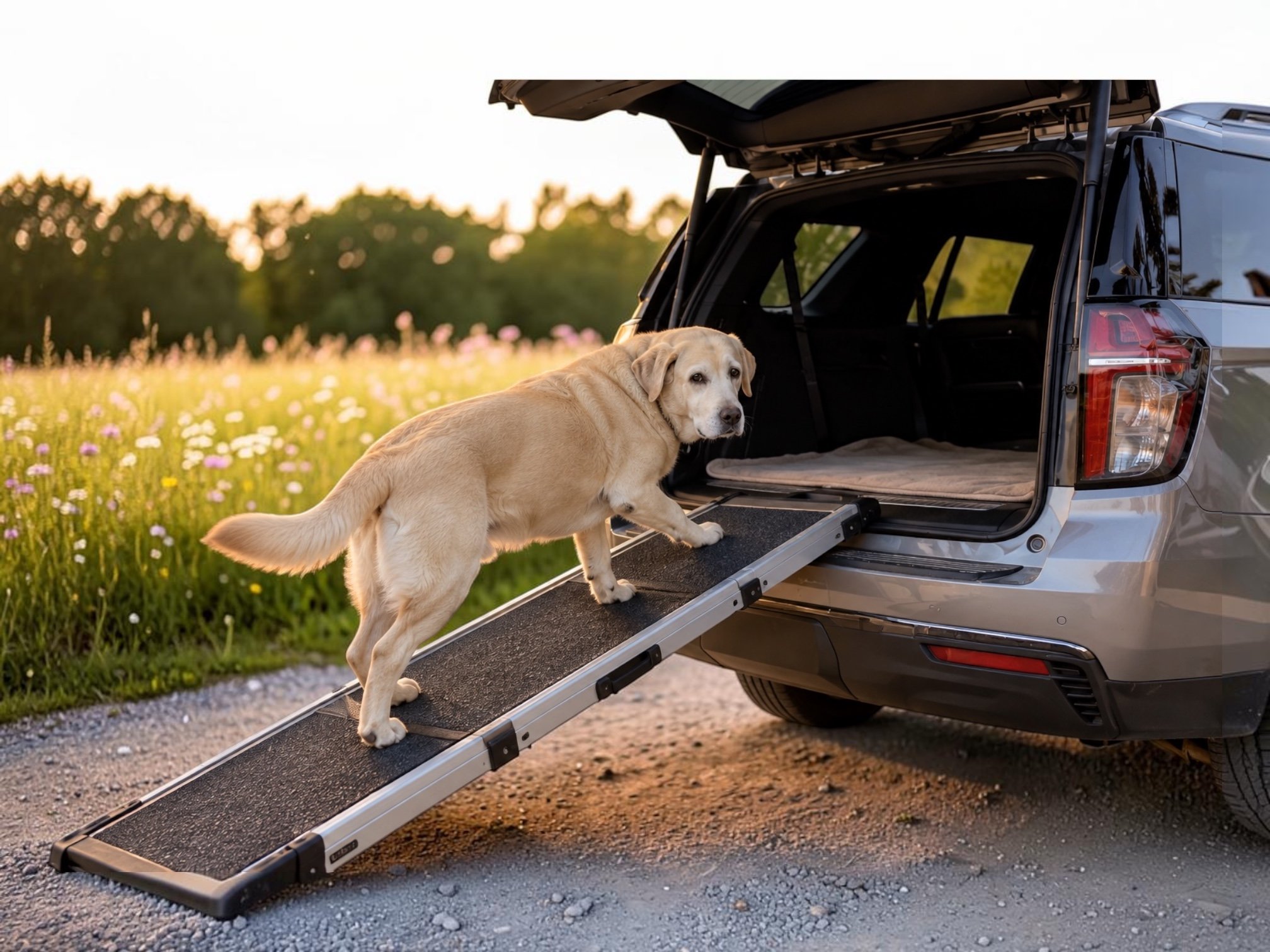
Labradors are enthusiastic by nature. Given the opportunity, most would happily launch themselves out of the back of an SUV without giving their joints a second thought! A quality ramp provides a more controlled way to enter and exit a vehicle and can be especially helpful for growing puppies, senior dogs, and Labs recovering from an injury or experiencing reduced mobility.
Why We Recommend Teaching Your Labrador to Use a Ramp
Many people don’t think about purchasing a ramp until their dog is older or already experiencing mobility problems. We prefer a different approach:
Teach your Labrador to use a ramp while they are young, healthy, and confident.
When ramp walking becomes an ordinary part of life, your dog won't have to learn an unfamiliar skill at the very time that climbing, jumping, or balancing may already be difficult.
This is especially useful with taller SUVs and trucks. Remember that the ramp isn't only about helping your dog get into the vehicle. We also want to reduce those dramatic Labrador leaps out of the vehicle.
Our Dog Ramp Recommendations
GOOD: Pet Gear Travel Lite Bi-Fold Ramp with SupertraX
A practical choice for lower vehicles and occasional use
The Pet Gear Travel Lite Bi-Fold is a good starting option for families with cars, crossovers, and lower SUVs. We especially like the SupertraX walking surface, which gives paws additional grip.
Its folding design also makes it convenient to store in a vehicle.
CaveInn recommends it for:
Cars, crossovers, lower SUVs, and families wanting an economical first ramp.
Keep in mind:
With a tall SUV or truck, a shorter ramp can create a fairly steep incline. Measure your vehicle's entry height before deciding that a compact ramp is the best choice.
BETTER: PetSafe Happy Ride Telescoping Dog Ramp
Our everyday choice for many Labrador families
The PetSafe Happy Ride Telescoping Ramp offers a nice combination of portability, adjustability, and stability.
Because it telescopes, you can adjust the length to better accommodate your particular vehicle. The standard model extends to approximately 72 inches and weighs about 13 pounds, making it considerably easier to handle than some heavier folding ramps.
It also features raised side rails and a high-traction walking surface.
CaveInn recommends it for:
Most standard SUVs and crossovers and families looking for a ramp that can serve their Labrador from puppyhood through adulthood.
Why we like it:
It's lightweight enough to actually use regularly, yet substantial enough for a Labrador.
BEST FOR TALL VEHICLES: PetSafe Happy Ride Extra Long Telescoping Dog Ramp
Our preferred option for tall SUVs, trucks, and senior Labradors
For a full-size SUV such as a Tahoe or Suburban, a pickup truck, or a Labrador that would benefit from a gentler incline, we prefer the Extra Long version of the PetSafe Happy Ride.
It extends to approximately 87 inches and is about 20 inches wide. That additional length can make an important difference when you're trying to create a comfortable approach to a tall vehicle.
The longer ramp is also worth considering for senior Labs. Even if a shorter ramp technically reaches the vehicle, that doesn't necessarily mean it provides the easiest incline for the dog.
CaveInn recommends it for:
Full-size SUVs, pickups, senior Labradors, dogs with reduced mobility, and families wanting a ramp they can continue using throughout their dog's lifetime.
The CaveInn Way: Teach It Before You Need It
A ramp is much easier to introduce when your puppy thinks it's simply another fun training exercise.
Begin with the ramp completely flat on the ground.
Allow your puppy to investigate it. Use small treats, praise, and positive reinforcement to encourage them to walk across the surface. Reward calm, confident movement.
Once your puppy is comfortable walking across the flat ramp, introduce a very slight incline. Gradually increase the angle as your puppy becomes confident.
What Should You Look for in a Dog Ramp?
Not all dog ramps are created equal. For a Labrador Retriever, we recommend considering four things:
Length: A longer ramp creates a more gradual incline. This becomes particularly important with taller SUVs and trucks.
Traction: Your Labrador should have a secure, non-slip surface under all four feet. A slippery ramp can quickly make a puppy or adult dog reluctant to try it again.
Stability: The ramp should feel solid underfoot without excessive bouncing or shifting.
Width: Your Labrador should have enough room to walk comfortably without feeling as though they are balancing on a narrow surface.
And don't forget practicality. If the ramp is so heavy or cumbersome that you leave it in the garage, it isn't going to protect anybody's joints!
🐾 CaveInn Labradors — Raising them with purpose. Loving them for a lifetime.
Remember:
Never drag, pull, or force a reluctant puppy onto a ramp.
If your puppy hesitates, make the exercise easier. Lower the incline, increase the reward, and try again. Patience and repetition build confidence.
Practice walking both up AND down the ramp. Going down can actually feel more intimidating to a puppy than going up.
Eventually, using the ramp should become as ordinary as walking through a doorway.
A Small Investment in a Lifetime of Adventures
No single product can guarantee that a Labrador will never experience joint problems. Genetics, body condition, nutrition, appropriate exercise, environment, and many other factors contribute to lifelong orthopedic health.
A ramp is simply another useful tool.
At CaveInn Labradors, we put tremendous thought into the health of our dogs before a breeding ever takes place. We believe that same thoughtful approach should continue throughout the life of every puppy we raise.
Whether your CaveInn Labrador is eight weeks old or twelve years young, we'd much rather see them walk down the ramp than take the flying-Labrador shortcut!